


From Stagnation to Sensation: How AIGC-Powered Retrospection Revives YouTube Shorts
Article Summary: A hands-on guide for creators leveraging AI-generated content (AIGC) to jumpstart YouTube Shorts growth. This article walks you through a retrospection-based workflow: evaluating past performance, mining data for insight, optimizing content strategy, and implementing AI-assisted production. Alongside clear metric benchmarks and real-world examples, you’ll discover how to turn a plateaued channel into a consistently growing Shorts engine.

For YouTube Shorts creators, especially teams leveraging AIGC to produce content at scale, an effective retrospection process is the key to evolving from occasional viral hits to consistent, sustainable growth. It transforms your creative process from one based on gut feelings into a disciplined, scientific method.
This article will break down how to conduct data-driven retrospectives, establish a smart optimization rhythm, and provide real-world case studies to help you make the critical decision: should you persevere or pivot when your traffic stalls?
💡Our Methodology: Insights Forged in Data and Practice: The insights shared in this article are not theoretical musings but are forged from our team's extensive experience and deep analysis. We have consulted for and thoroughly dissected the performance of over 50 AIGC-focused YouTube Shorts channels, which collectively generated more than 1 billion views. This hands-on experience, coupled with rigorous data analytics and A/B testing, forms the bedrock of our recommendations. What you'll find within these pages is not just a guide, but a battle-tested blueprint for sustainable growth on YouTube Shorts, validated by real-world results.
I. The Core of Effective Retrospection: Data-Driven and Structural Analysis
The goal of a retrospective is to uncover why a video underperformed or unexpectedly succeeded, thereby informing your next creative cycle. This requires us to focus on the core metrics that the platform prioritizes and to deconstruct our content structurally.
1. The Two Core Metrics Driving the Algorithm
The YouTube Shorts algorithm is relatively straightforward and decisive. It heavily weighs two user behaviors that occur in a split second: the decision to watch and the decision to stay.
1.1. Selection Rate (Viewed vs. Swiped Away)
This is the percentage of users who, upon seeing your Short (usually the first frame), stop swiping and choose to watch it. It’s the first critical gatekeeper that determines whether the algorithm will push your content to a larger audience pool.
- 📌 Importance: Your Selection Rate hinges on creating immediate tension and setting expectations from the very first second. If this metric is poor, your immediate focus should be on optimizing the video's "packaging"—especially the hook within the first 3 seconds.
- 💡 The Viral Threshold: A video with true viral potential typically needs a Selection Rate of 80% or higher. One creator, through data analysis, realized an opening special effect was unnecessary flair. After removing it, his Selection Rate jumped from 69% to 78.9%, resulting in millions of additional views.
Shorts Viral Threshold Benchmarks
To help you quickly assess your Shorts' potential, consult the following benchmarks for "Viewed vs. Swiped Away Rate" and "Average Percentage Viewed" across different video durations.
These are critical indicators that YouTube's algorithm prioritizes for pushing content to a wider audience.
Performance Benchmarks
| Metric | Potential Hit (Good) | Viral Hit (Great) | Gold Standard (Explosive) |
|---|---|---|---|
| Selection Rate (Viewed vs. Swiped Away) |
> 75% | > 80% | > 85% |
| Average Percentage Viewed (APV for <15s Short) |
> 120% (18s) | > 140% (21s) | > 180% (27s) |
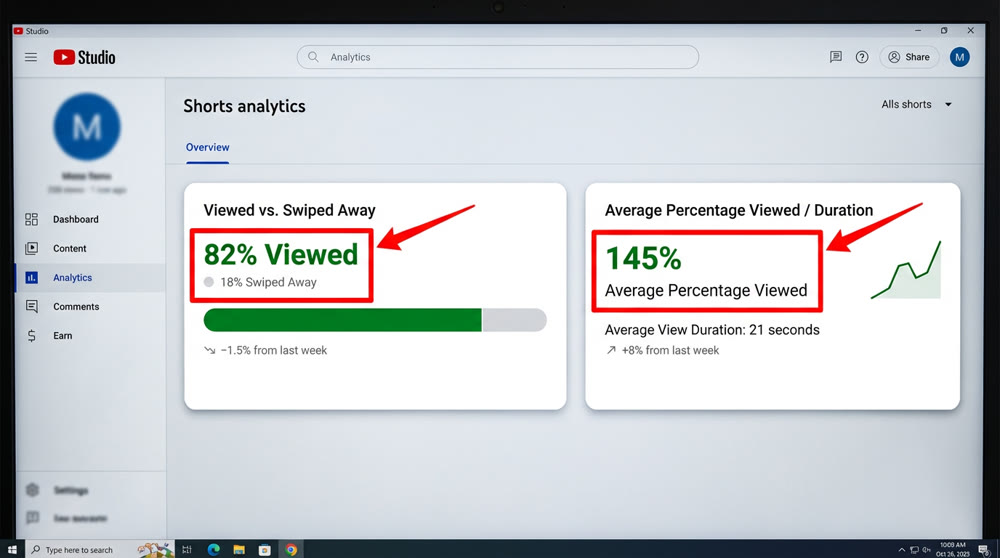
1.2. Average View Duration (AVD) / Average Percentage Viewed (APV)
This metric reflects whether your script and pacing successfully held the audience's attention. For Shorts, a high completion rate—or even repeat views—significantly increases the potential for ad impressions and algorithmic favor.
- 📌 The Gold Standard: An average of two or more views per viewer (an APV of 200%+) is an exceptionally high bar. Generally, for a 15-second Short, an APV of 140% or more (averaging 21+ seconds of watch time) is considered excellent.
- 💡 Optimization Focus: Pay close attention to the sharp drop-offs in your audience retention curve in YouTube Studio. If the drop occurs near the end, your conclusion is likely too slow. An advanced technique is to create a seamless loop where the final frame connects back to the first, encouraging repeat watches and boosting your AVD.
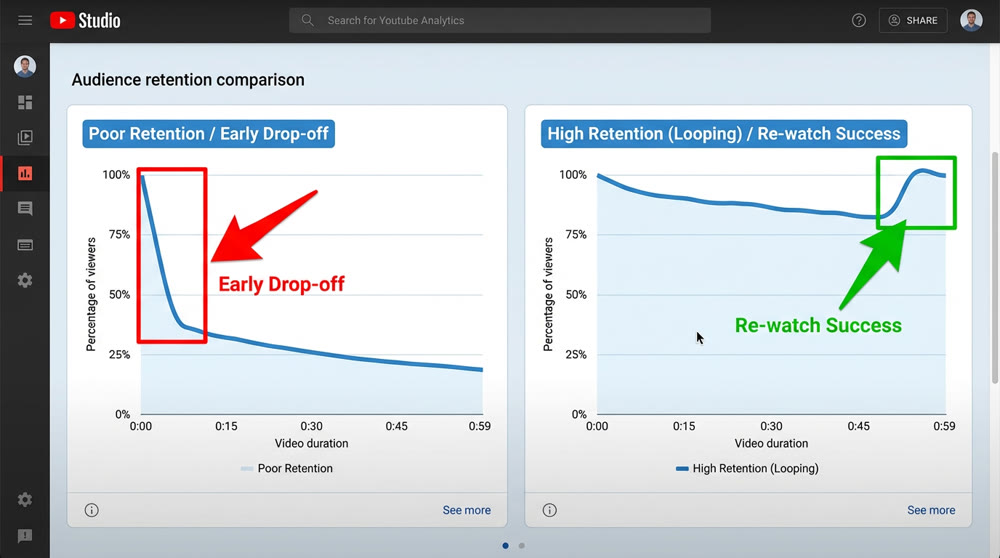
When data is disappointing, avoid making blind changes. Instead, deconstruct your content along three axes to pinpoint the problem:
| Axis | Dimension | Key Questions for Analysis |
|---|---|---|
| Hook (The Packaging) |
First 1–3 seconds, thumbnail frame, title |
Does the opening frame create immediate curiosity or tension? Is the value proposition clear at first sight? Does it visually stand out from similar content? |
| Script (The Core) |
Story structure, pacing, emotional arc, sound design |
Is the story compelling? Is the pacing smooth or rushed/dragging? Are there any dead spots where viewers drop off? Does the audio reinforce the emotion & rhythm? |
| Relative Quality (The Execution) |
Visual sharpness, audio clarity, editing flow, overall polish |
Compared with top performers in your niche, is your quality competitive? Are the visuals clear, stable and engaging? Does the editing feel tight and professional? |
- ✨ Tools & Advanced Analysis: AI tools can be powerful allies in your retrospective process, helping you understand the "why" behind the data.
- YouTube Studio: Check your video’s "Reach" (impressions). If impressions are zero, there might be an issue with your account. If impressions are high but views are zero, the problem is almost certainly your content's hook.
- AI Analysis: Feed screenshots of your audience retention curve or data reports directly into tools like Google Gemini or GPT-4o. Ask the AI to summarize key moments of engagement and suggest optimization strategies.
- [Advanced] Script Deconstruction: Use prompt templates in a tool like Google AI Studio to analyze competitor videos. By inputting a video link, you can have the AI generate a shot-by-shot script and prompt analysis, streamlining the process from replication to creative adaptation.
II. Optimization Cadence and Content Iteration Strategy
Your approach to retrospection and optimization should evolve as your channel grows. Beginners need to quickly validate a workflow, while mature creators must focus on controlled experiments and incremental improvements.
1. Beginner Phase (0 to 10k+ Stable Views): Prioritize Completion Over Perfection
The primary goal in the beginning is to overcome creative inertia, set realistic expectations, and rapidly adapt to the platform's ecosystem.
| Stage | Key Objective | Mindset & Actions |
|---|---|---|
| First 1–3 Videos | Break the ice | “Done is better than perfect.” Focus on completing the entire production and publishing workflow. |
| First 1–2 Weeks | Find your rhythm | Aim for consistency in output frequency. Experiment with different hooks, styles, and topics. Don’t over-analyze — just ship. |
| First Month | Validate a direction | Identify which videos get any traction (even a few thousand views). This is your first signal of what might work. |
A creator we know spent months paralyzed by technical minutiae. It wasn't until a mentor told him to "just post it" that he broke through his hesitation. He learned that the first one or two channels are often for trial and error; bold experimentation is the only way to develop an intuitive feel for the platform.
2. The Plateau Phase (From 10k Views to a Viral Hit): Control Variables, Innovate Incrementally
Breaking past the 10k-50k view range is a critical milestone. At this stage, your retrospection should focus on identifying the "outlier" factors in your successful videos and conducting targeted micro-innovations.
2.1. Data Monitoring and Action Cadence
- 3 Hours Post-Launch: Check the Selection Rate. If it's abysmal (e.g., below 70%), it signals a complete failure of the hook. Consider hiding or deleting the video to avoid negative signals to the algorithm.
- 15-20 Days Post-Launch: Observe if the algorithm gives the video a second wind. Once a video breaks 50,000 views, conduct a deep-dive retrospective to analyze its success factors.
2.2. Evolving from Imitation to Adaptation
To break through the plateau, you must either outperform your competitors or discover an untapped combination of viral elements.
- 💡 Recombining Viral Elements (Viral + Viral): Combine two proven viral concepts. For example, a video merging Squid Game (a hot IP) with AI-generated characters from the Classic of Mountains and Seas (a distinct aesthetic) generated millions of views.
- 💡 Keep the Structure, Swap the Variables: Extract the universal structure from a viral script (e.g., rescue, mockery, comeback). Then, create new hits by swapping variables like characters, IPs, settings, or outcomes.
- Case Study: A creator successfully adapted a script about a cat father rescuing his kitten into a video about construction workers forming a human ladder to save a baby in a high-rise. Despite the drastic change in elements, the core narrative structure remained, and the video garnered tens of millions of views.
- ✨ [Advanced] Cross-Niche Adaptation: This "strategy arbitrage"—applying proven formulas from a more mature niche (like live-action skits or 3D animation) to a less developed one (like AI K-pop stories or animal narratives)—has been incredibly effective in niches like Indian folklore.
3. The YPP & Beyond (Sustaining Success and Handling Decline)
Even after successfully joining the YouTube Partner Program (YPP), the peak lifespan of a broad entertainment Shorts channel is often just 1-3 months. Afterward, the account may enter a "decline phase," where new videos have excellent initial metrics (e.g., 80% Selection Rate) but fail to get significant algorithmic push, getting stuck at around 10k views.
Your strategy must then shift towards efficiency, scale, and content evolution:
- Efficiency and Automation: Automate your content production workflow to enable the mass production of high-quality videos. The goal isn't just automation; it's to create a lever to amplify your successful formulas. By focusing his energy on refining his "AI brain" instead of manual tasks, one creator successfully managed a portfolio of over a dozen channels without being flagged for repetitive content.
- Channel Portfolio (Matrix) Operation: Continuously launch new "feeder" channels using your validated viral scripts. This ensures that you always have a few channels in their peak phase, maintaining stable overall revenue.
- Content Evolution:
- Long-Form and Short-Form Synergy: Use the high traffic and subscriber velocity from Shorts to drive audiences to long-form videos, which can have an RPM (revenue per mille) up to 10 times higher.
- Pivoting to a Vertical Niche: Transition from broad entertainment to a niche with unique value (e.g., gaming, science explainers, language learning stories). This builds a loyal fanbase and extends the channel's lifespan.
III. The Critical Decision: Pivot or Persevere?
When your data slumps, the toughest call is determining whether the problem lies with your niche or your content.
1. When to Persevere: It's a Content & Execution Problem
If your competitors in the same niche are still producing videos with millions of views, it's a clear sign that the market demand exists and the niche is viable. The problem is likely with your content.
| Symptom | Diagnosis | Solution |
|---|---|---|
| New videos get stuck at a few thousand views |
Your hook or story is not resonating. |
Go back to basics: analyze top-performing videos in your niche. What hooks are they using? What emotional beats are they hitting? |
| Consistently low Selection Rate (<70%) |
Your "packaging" is failing. |
A/B test your first frame, title, and opening 3 seconds relentlessly. What you think is a great hook might not be. |
| High Selection Rate, but low AVD |
Your hook works, but the payoff is weak. |
Analyze your audience retention graph to see where people drop off. Is your story boring? Is the pacing too slow? |
2. When to Pivot: It's a Niche, Account, or Policy Problem
When external factors create irreversible headwinds, you need to let go of your current approach and quickly change direction.
- Niche Lifespan is Over or Hyper-Competitive: If no channel in your niche has produced a multi-million view video in the last month, the trend may have run its course. It’s time to find a new angle.
- Overcoming 'Long-Termism' Bias: A creator, "Alex," was committed to the long game in the storytelling niche. After realizing that revenue follows traffic, he abandoned his underperforming "long-term" strategy to chase a hot IP (Squid Game). He quickly gained millions of views, proving the value of a traffic-first mindset in the short term.
- ⚠️ Navigating YouTube's Policy Red Lines: If your content touches on sensitive policy areas, stop production and clean up your channel immediately.
- Originality & Repetitive Content: Avoid highly templated, low-effort content, which YouTube may classify as "spam, deceptive practices, and scams."
- Copyright & Safety: Do not use copyrighted clips (e.g., from TV shows like America's Got Talent). Strictly avoid content that depicts minors in dangerous situations (this includes child-like IPs and baby animals), is gratuitously graphic or disgusting, or defames real individuals, as these are likely to trigger user reports and channel strikes.
- Risk Warning: Creators have had their channels terminated for content involving child endangerment or perceived defamation of public figures, with a very low success rate for appeals.
IV. Case Studies: The Path from Confusion to Viral Success
Every successful creator's journey is paved with rigorous retrospection and decisive pivots.
1. J.Q.'s Four Stages of Viral Evolution: From Imitation to Innovative Fission
A creator we'll call "J.Q." achieved a qualitative leap in her content through a planned, iterative strategy.
| Stage | Strategy | Action | Result |
|---|---|---|---|
| 1. Imitation | Replicate a proven viral hit |
Found a viral "cat rescue" video and recreated it exactly. |
Validated the script's potential. |
| 2. Adaptation | Keep the structure, swap variables |
Changed the characters to a different IP but kept the "rescue" theme. |
Achieved a much bigger viral hit. |
| 3. Combination | Merge two viral elements |
Combined a hot IP with a unique visual style. |
Unlocked a new, successful formula. |
| 4. Fission | Scale the new formula |
Created multiple variations of the new successful formula. |
Built a stable of high-performing content. |
2. Efficiency First: S.Z.'s Automation and Matrix Validation
Another creator, "S.Z.," focused from day one on the potential for efficient, scalable success rather than pouring all his energy into a single video.
- Core Mindset: He avoided getting emotionally attached to any one video, which prevented burnout from a video stalling at 10k views. He invested his time in refining his "AI brain"—the prompts and workflows that powered his content engine—and simplifying every time-consuming manual step.
- Strategy & Execution: After identifying an underserved niche and creating a viral hit, he immediately used automation tools, like combining Genmi AI's Text-to-Video and Image-to-Video generators with scripting via Gemini, to replicate his success at scale.
- Results: S.Z. successfully managed a portfolio of over a dozen channels for months without any "repetitive content" violations, proving that mass-producing high-quality viral content with AI is not just possible, but highly effective.
✨ Key Insight: If earning a few thousand dollars a month is the ceiling for manual content creation, automation can multiply that ceiling many times over. But the prerequisite is clear: you must first be able to consistently produce a hit.
Take Your AIGC Content to the Next Level
The journey from a struggling creator to a systematic content powerhouse isn't about working harder; it's about working smarter. It’s about building a data-driven feedback loop, knowing when to double down and when to pivot, and leveraging the right tools to scale your successes.
The case studies of J.Q. and S.Z. show that the ultimate competitive advantage lies in building efficient, automated systems. Instead of manually crafting every video, you can focus on designing the "AI brain" that generates viral hits for you.
Ready to stop guessing and start scaling? Explore Genmi AI to see how you can automate your video creation workflow and turn your proven formulas into a content empire.

Recommended Articles

Decoding the YouTube Shorts Algorithm: A Data-Driven Guide to Viral Growth
Decode the YouTube Shorts algorithm. Learn the key metrics (CVR, AVP) and data-driven strategies to break view plateaus and achieve explosive channel growth.

Higgsfield AI Review 2025: Unpacking Its Cinematic Power and Realism
Is Higgsfield AI the right creative tool for you? My review tests its photorealistic images, unique camera controls, and character motion quality.

An In-Depth WAN 2.2 Review: Redefining AI Video Motion Control
Explore our WAN 2.2 review. We analyze its advanced motion control, prompt accuracy, and how it compares to other top models in the AI video space.