


Higgsfield AI Review 2025: Unpacking Its Cinematic Power and Realism
Article Summary: This article offers an in-depth review of Higgsfield AI, evaluating its unique strengths in photorealistic imagery and camera motion against its limitations in video character realism and overall creative flexibility.
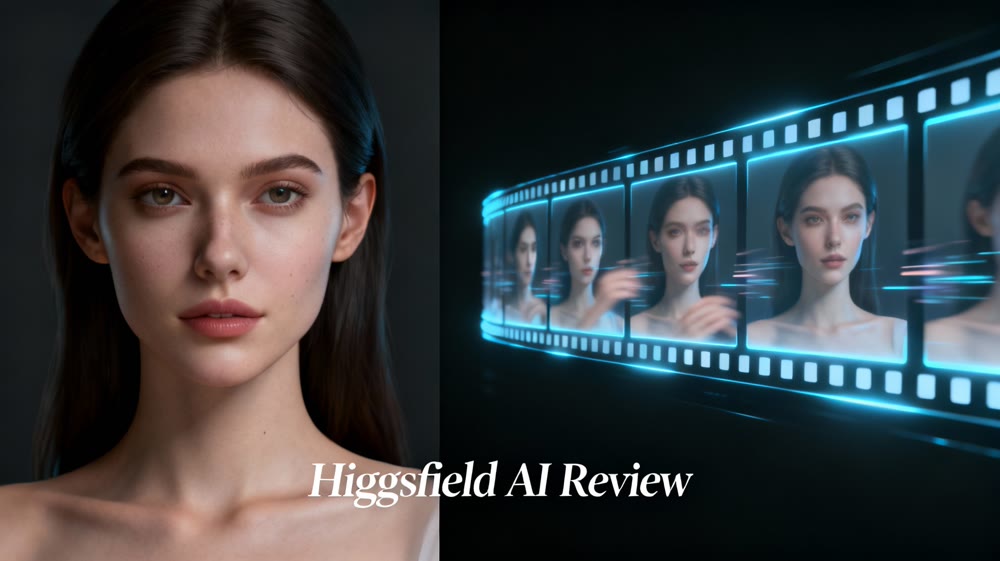
In the fast-paced world of digital creation, the ultimate goal is often to find a single, powerful tool that can seamlessly bring an idea to life. Yet, many creators find themselves navigating a fragmented landscape, using one platform for ideation, another for image creation, and a third for motion. This raises a critical question: can one platform truly master both static visuals and dynamic movement?
This is the promise of Higgsfield AI, a platform developed by former Snapchat AI talent that has secured significant funding and attention. It aims to be a one-stop shop, taking you from a simple concept to a finished visual story. In this article, we provide a comprehensive look at what Higgsfield offers, testing its highly-praised image realism and unique motion capabilities. We'll help you understand its strengths, weaknesses, and whether it's the right fit for your creative workflow. For those new to the space, you can explore some foundational guides on how to make AI videos to better understand the technology.
What Makes Higgsfield AI Stand Out?
Higgsfield's most compelling feature is its proprietary image model, 'Soul,' which specializes in creating hyper-realistic, high-aesthetic imagery that often blurs the line between AI-created and professionally photographed. It offers over 50 stylistic presets—from "Tokyo Streetstyle" to "Overexposed"—allowing creators to quickly achieve a specific look without extensive prompt engineering.
Where the platform truly carves out its niche is with the Higgsfield AI video generator capabilities, which are focused on character-centric visuals and advanced camera motion. Rather than simple animations, Higgsfield provides a suite of cinematic controls like "Crash Zooms," "FPV Drone," and "360 Orbits." This makes it an incredibly powerful tool for a specific type of creator, such as music video directors or commercial filmmakers, who need precise control over shot composition and character movement. It's less about general-purpose visual creation and more about crafting a specific, cinematic human story.

A Hands-On Higgsfield AI Review
To see if the performance matched the promise, we put both the image and motion tools to the test.
The Image Test: Unmatched Realism
We started with a detailed prompt to challenge the 'Soul' model's ability to render a realistic, fashion-forward scene.
Prompt:
“A young fashion model with tattoos around her body poses confidently in a temple, standing beside a row of tall red columns. She wears an urban-fashion outfit made up of a vintage cropped tee and denim jeans that reflects modern Japanese street style.”
The result was stunning. The image produced was incredibly lifelike, avoiding the glossy, artificial look common in many AI tools. The character felt authentic, and the lighting and environmental details were impeccable. For pure photorealistic image creation, Higgsfield is undeniably top-tier.

The Motion Test: Cinematic Flair with Flaws
Next, we tested its ability to animate still images with a prompt focused on subtle human expression and movement.
Prompt:
“A woman savors red wine from a crystal glass, her expression calm and introspective. The camera gracefully arcs right around her, revealing her quiet sophistication and satisfaction with each sip.”
Our experience with Higgsfield AI's motion capabilities revealed a different story. While the camera movement was smooth and cinematic, the character herself appeared stiff and unnatural. Her skin had an artificial gloss, and her movements didn't fully align with the prompt—she touched the glass to her lips but never truly sipped. The result lacked the lifelike quality of its static images, highlighting a gap between its image and motion rendering engines.
The Need for a Unified Creative Workflow: Genmi AI Helps!
Higgsfield excels as a specialized tool, but our test highlights a common challenge in the creative process: a disconnect between different stages of production. You might create a perfect, photorealistic character image, only to find that the motion tool can't replicate that same level of realism. This forces creators to compromise their vision.
This is where the vision for a unified creative platform becomes so compelling. Tools like Genmi AI are designed to solve this very problem by integrating the entire workflow into a single, cohesive ecosystem. Instead of being limited to one function, you can move seamlessly between different modes of creation. For example, you could generate an initial character concept, refine every detail using powerful image-to-image refinement tools, and then animate that perfected character, all while maintaining a consistent level of quality and artistic control. This holistic approach minimizes friction and empowers creators to execute their vision without compromise.
Conclusion: The Final Verdict on Higgsfield AI
So, what is our final take? Higgsfield AI is a powerful and impressive platform with a clear, specialized strength: creating photorealistic images and applying sophisticated camera movements to character-focused scenes. If your work is heavily reliant on these specific features, Higgsfield is a compelling option that can produce results other tools can't easily match.
However, its limitations are equally clear. The disconnect in quality between its image and motion outputs, coupled with its niche focus, means it isn't a versatile, all-in-one solution for every creator. Its strength in realism also means it's less suited for abstract or stylized projects.
For creators who require flexibility, consistency, and a more comprehensive set of tools to bring diverse ideas to life, exploring an integrated creative suite like Genmi AI may be a more strategic choice. The best tools are those that adapt to your vision, not the other way around. The key is to find the right creative partner for your unique journey.
Recommended Articles
A Hands-On PixAI Review: The Go-To Tool for Anime Art?
Our in-depth PixAI review evaluates its features for anime art, including image quality and editing tools.

YouTube Shorts vs. Long-Form Video: The Ultimate Revenue Showdown
Discover the key differences in YouTube Shorts vs. long-form video monetization. Learn about RPM, ad revenue, and which format is best for you.
From Shorts to Features: Two Proven Playbooks for Creating Long-Form AI Videos on YouTube
Learn two proven playbooks for creating long-form AI videos on YouTube. Master content compilation and cinematic narratives to boost RPM and channel growth.