


YouTube Monetization Unlocked: A Deep Dive into YPP and Shorts Revenue for AIGC Creators
Article Summary: This comprehensive guide explains the YouTube Partner Program (YPP), comparing Shorts and long-form monetization. It details strategies for AIGC creators to increase RPM, navigate compliance, and diversify revenue streams, featuring actionable tips and benchmarks to accelerate channel growth and profitability with tools like Genmi AI.
The YouTube Partner Program (YPP) is the gateway for creators to monetize their content directly on the platform. By rewarding content producers with the majority of ad revenue and offering a suite of fan-funding features, it lays the foundation for building a sustainable creator business.
I. The Core Mechanics of the YouTube Partner Program (YPP)
Understanding the YPP is the first step toward earning an income on YouTube. Here's a breakdown of how it works.
1. YPP Eligibility Requirements and Tiers
YouTube has established two main entry points into the YPP, designed to support creators at different stages of their journey:
| Eligibility Tier | Subscribers | Public Watch Hours (Long-Form) |
OR | Public Shorts Views (Last 90 Days) |
Unlocks |
|---|---|---|---|---|---|
| Initial Tier | 500 | 3,000 hours | OR | 3 million | Fan Funding (Memberships, Super Thanks, etc.) |
| Full YPP | 1,000 | 4,000 hours | OR | 10 million | Ad Revenue + All Initial Tier Features |
📌 Important Note: YPP eligibility data often has a 5–7 day lag. Even after you hit the metrics, you may need to wait a few days before the "Apply" button becomes available. Once you're approved for the initial tier, you will automatically be granted full YPP benefits upon meeting the higher-tier requirements—no second review needed.
2. The Essential Application and Setup Process
To ensure a smooth YPP approval process and begin monetizing, creators must complete several critical setup steps:
- Link an AdSense Account: All monetization revenue is processed and managed through a Google AdSense account.
- When registering for AdSense, you must provide accurate payment information and a real physical address to receive a verification PIN by mail.
- 💡 Pro Tip: It's wise to link no more than 2–3 YouTube channels to a single AdSense account. This mitigates risk; if one channel violates a policy, it won't automatically jeopardize the monetization of all associated channels.
- You can apply for an AdSense account even before you meet the initial YPP requirements to get a head start.
- Set Your Channel's Country: Your channel's country must be set to a region where the YPP is available (e.g., United States, South Korea, Japan). Monetization is not available in all countries. This setting is crucial for enabling YPP and affiliate marketing features.
- Content Compliance Review: Your channel must adhere to YouTube's Community Guidelines and Ad-Friendly Content Policies. Before applying, it's best practice to conduct a channel audit:
- Keep records of your creative process (e.g., raw footage, project files) to prove originality in case of an appeal.
- Clean up your channel by deleting or unlisting underperforming or inconsistent Shorts and long-form videos to avoid being rejected for having a disjointed content library.
- Avoid posting highly repetitive, sensationalist, or derogatory content. This type of content can lead to channel removal or YPP rejection.
3. Ad Revenue Share and the Value of a Monetized Account
Creators on YouTube receive a 55% share of the ad revenue generated from their long-form videos.
A monetized YPP account itself is a marketable asset. On the open market, a channel with full YPP eligibility often sells for around $200–$250, reflecting the inherent value of having a pre-approved foundation for monetization.
If you want to compete with teams, building a scalable YouTube Shorts workflow SOP is the only way to manage daily uploads.
II. Revenue Drivers and the Logic of Shorts Monetization
YouTube ad revenue isn't distributed evenly. It's highly dependent on content type, audience demographics, and video performance. Understanding these drivers is key to maximizing your earnings, especially with Shorts.
1. Core Revenue Metric: The Impact of RPM and Geography
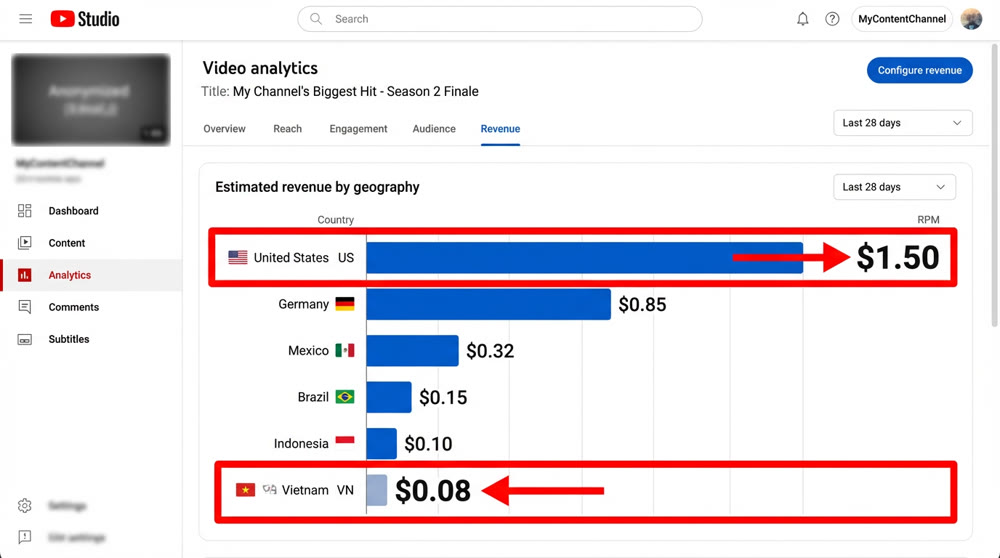
The key metric for your earnings is RPM (Revenue Per Mille), which is the revenue you earn per 1,000 views. This is different from CPM (Cost Per Mille), which is the cost an advertiser pays to YouTube per 1,000 ad impressions. Your RPM is what's left after YouTube takes its share.
Audience location is the single biggest factor influencing RPM.
| Audience Region | Typical RPM | Why? |
|---|---|---|
| Tier 1 Countries (e.g., US, UK, Canada, Australia) |
High ($5 – $30+) |
Higher advertiser competition and consumer purchasing power. |
| Developing Regions | Low ($0.50 – $2) |
Lower advertiser budgets and market saturation. |
📌 Technique: How to Target High-Value Audiences
If you want to increase your RPM, your primary strategy should be creating content that appeals to viewers in high-RPM regions.
- Use the Target Language: Using English, Spanish, Japanese, or Korean in your titles, descriptions, and voice-overs will help the algorithm push your content to those language speakers, naturally increasing your percentage of viewers from developed countries.
- Focus on a Niche: For example, a channel focused on the AI niche has significant potential for international brand deals. Many AI companies are looking for targeted channels to advertise on, creating lucrative opportunities. Creating high-quality long-form content consistently can be challenging, but tools like Genmi AI's image-to-video generator can streamline the process, helping you produce more content for these high-value niches.
- 💡 Pro Tip: Data Analysis: Use tools to analyze your competitors' audience geography. Adjust your content strategy and language to attract high-RPM demographics.
- Tools:
- Viewstats: For estimating revenue and analyzing top-performing channels.
- YouTube Studio: For analyzing your own audience's geographic distribution.
2. The Unique Logic of Shorts Ad Revenue
The monetization model for Shorts is fundamentally different from traditional long-form videos.
- Shared Revenue Pool: Shorts revenue isn't tied to ads on your individual videos. Instead, revenue from ads shown between videos in the Shorts feed is collected into a "Creator Pool."
- Proportional Payout: Your share of this pool is determined by your videos' percentage of the total views from all monetizing creators' Shorts in a given country.
- This pool also includes revenue from display and non-skippable ads shown in the Shorts experience.
Comparing Revenue: Shorts vs. Long-Form Videos
While Shorts can generate massive views and help you qualify for YPP quickly, long-form videos are overwhelmingly superior for ad revenue.
| Content Format | Primary Advantage | Monetization Profile | Strategic Use |
|---|---|---|---|
| YouTube Shorts | Rapid audience growth, high virality potential. |
Low RPM, inconsistent revenue from ad pool. |
Lead Generation: Quickly gain subscribers and test viral script ideas. YPP Qualifier: A fast track to meeting monetization requirements. |
| Long-Form Video | Stable, high-value ad revenue. |
High RPM, predictable income streams. |
Main Revenue Driver: The battlefield for sustainable, long-term income. |
✨ Think of it this way: Shorts are your "customer acquisition" channel, and long-form videos are your "profit center."
3. 💡 Advanced Metrics for Shorts Reach & Revenue
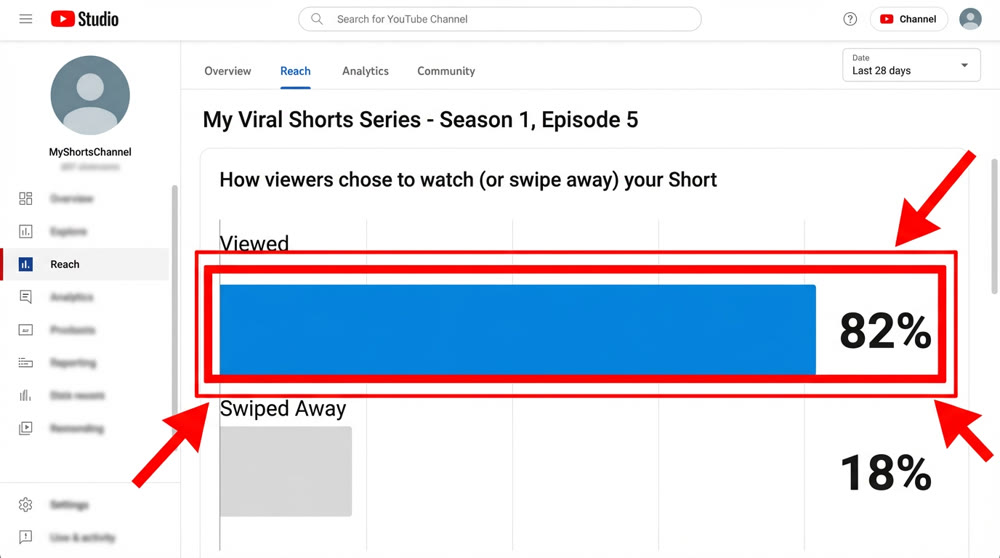
The Shorts algorithm prioritizes two key metrics to decide whether to push your video to a wider audience:
- Viewed vs. Swiped Away Rate: The percentage of viewers who choose to keep watching your Short instead of swiping away. An excellent rate is above 70%, while viral hits often exceed 80%.
- Average View Duration (AVD) & Average Percentage Viewed (APV): If a 15-second Short has an AVD of 21 seconds, it means people are re-watching it—a strong signal of a potential viral hit.
- Content Originality: The algorithm penalizes highly templated and unoriginal content. To break through view plateaus, you must differentiate by using fresh visuals, superior scripting, and higher overall production quality.
🚨 Risk Warning: Focus on producing high-quality, valuable content with a consistent upload schedule. Churning out low-effort, mass-produced videos will not only fail to go viral but could also get your channel flagged for "repetitive or reused content," leading to YPP rejection or even channel termination.
III. Diversified Monetization Models & Case Studies
Ad revenue is just the beginning. As your channel grows, diversifying your income sources will significantly raise your earning ceiling.
1. Fan Funding and Memberships
These features become available once you reach the initial YPP tier (500 subs + 3M Shorts views / 3K watch hours).
- Channel Memberships: Fans pay a monthly fee for exclusive perks. Creators receive a 70% share of the membership fee.
- Super Thanks / Super Chat: Viewers can make one-time payments to highlight their comments during live streams or on video uploads.
- YouTube Premium Revenue Share: When YouTube Premium subscribers watch your content, you earn a portion of their subscription fee based on their watch time.
2. Brand Deals, Affiliate Marketing, and E-commerce
Once you build a dedicated audience, external business opportunities become a major income source.
- Brand Sponsorships and Deals: This is a key revenue stream for channels with a substantial following. Rates often scale with subscribers:
- 10,000+ Subs: Up to ~$200 per sponsored video.
- 100,000+ Subs: Up to ~$2,000 per sponsored video.
- 💡 Pro Tip: Niche Brand Deals: Channels that focus on specific verticals, like AI tool tutorials, are highly sought after by companies with strong advertising needs. You can land high-value brand deals even with a smaller subscriber count.
- Affiliate Marketing & E-commerce: This allows you to earn commissions by sharing product links, without handling inventory or logistics.
- Eligibility: Typically requires 10,000 subscribers and full YPP status.
- How it works: Embed affiliate links from platforms like Amazon Associates or CJ Affiliate in your video descriptions and pinned comments.
- Revenue Expectation: While some product categories offer high commissions (10%–20%), users often click a link and buy other, lower-commission items. A realistic blended commission rate is often around 1%–2%. Still, it provides a steady, passive income stream.
- Case Study: One creator in our community found that even with low commission rates, participating in events like the YouTube Shopping affiliate program led to a quick accumulation of earnings. Another successfully integrated a popular snack brand into a viral story format, dramatically increasing conversion rates.
3. AI Shorts Revenue Benchmarks: A Quantitative Look
Although AI-generated Shorts typically have a low RPM, their high production efficiency and viral potential make them one of the best ways for new creators to get started and build a YPP-qualified asset. The table below, based on real data from creators, estimates the potential revenue from 10 million Shorts views, with the primary difference being audience geography.
| Audience Location | Example RPM | Estimated Revenue from 10M Views |
|---|---|---|
| Developing Regions (e.g., Southeast Asia) | $0.05 | $500 |
| Mixed International Audience | $0.15 | $1,500 |
| Tier 1 Countries (e.g., USA, UK) | $0.50 | $5,000 |
📌This data comes from an English-language channel that focuses on 'generating time-lapse photography of natural landscapes using AI'. Due to the universality of its content and its primary audience in North America and Europe, it achieved a high RPM.
Here's the hard truth: For the same number of views, your content's language and topic create a massive difference in RPM. This is precisely why AIGC creators should shift their focus from purely "visual trend" videos to "narrative-driven" content with strong scripting and a clear target audience. This is where AI can be a game-changer. By leveraging advanced tools like Genmi AI, creators can quickly generate compelling video narratives from simple prompts, overcoming the "scripting barrier" and tapping into higher-value audiences.
4. Other Diversified Revenue Streams
- Knowledge Products: Sell online courses, e-books, or offer 1-on-1 consulting if you have specialized expertise.
- Selling Monetized Accounts: Consistently producing and selling YPP-approved channels as assets can be a business in itself, with accounts fetching $200–$250.
📌According to data from mainstream account trading platforms such as Flippa and EpicNPC, a channel with a valid YPP account and no violation record typically has a market price between $200 and $250.
- Music Promotion Deals: Promote specific copyrighted songs in your Shorts to earn a share of revenue based on Premium member plays. ⚠️ Warning: Payouts for this were drastically cut (by 70-90%) in early 2024. It should only be considered a minor bonus, and videos must be over 35 seconds to qualify for the full (reduced) amount.
- App Promotions & Partnerships: Similar to affiliate marketing, partner with companies to promote their apps or products on a CPM or cost-per-sale basis.
- Exclusive Communities: Advanced creators may also explore building exclusive communities on platforms like Patreon or Substack to create a direct-to-fan revenue stream.
The landscape of YouTube monetization is constantly evolving, but the core principles remain: provide value, understand the platform, and leverage the best tools. For AIGC creators, the opportunity has never been greater. Instead of getting bogged down by the technical complexities of video production, you can now focus on what truly matters—your creative vision.
For a deeper dive into growing your audience from scratch, check out our guide on the four-stage YouTube growth strategy.
Ready to unlock your channel's full potential? Explore how Genmi AI can transform your ideas into high-quality videos and accelerate your journey to monetization. Start creating today and turn your content into a sustainable business.
Recommended Articles

DeeVid AI Review: A Deep Dive into Its Strengths and Limitations for Professional Video
Is DeeVid AI worth it for professional video? Our in-depth review tests its features, performance, and quality to see if it meets cinematic standards.

Decoding the YouTube Shorts Algorithm: A Data-Driven Guide to Viral Growth
Decode the YouTube Shorts algorithm. Learn the key metrics (CVR, AVP) and data-driven strategies to break view plateaus and achieve explosive channel growth.

Hailuo vs Kling vs Runway: The Ultimate AI Video Model Comparison
An in-depth analysis of Hailuo vs Kling vs Runway. Discover which AI video model excels in realism, physics, and creative control to find the best fit.