


The Best AI 3D Animation Tools of 2026: A VFX Supervisor's In-Production Guide
Article Summary: A veteran VFX supervisor provides a strategic guide to the best AI 3D animation tools of 2026. The article analyzes which platforms are best for cinematic concepts (Sora, Veo), professional control (Runway), and solving 3D production bottlenecks (Tripo AI, DeepMotion) for a professional workflow.
I’ve spent over two decades in post-production, wrestling with render farms, complex rigging, and tight deadlines. The last few years, however, have felt like an entirely different universe. The question I get daily from studio heads and fellow artists is no longer if we should use AI, but how. The market is a dizzying array of competing platforms, each claiming to be revolutionary. This has made finding the best AI 3d animation tools a deeply confusing and high-stakes challenge.
This article is the guide I wish I had. We're moving past the "wow factor" of early AI video and into a mature ecosystem of specialized, production-ready tools. Forget trying to find a single "best" platform; that's a fool's errand. Instead, this analysis will provide you with a strategic framework—a professional's perspective on which tools to deploy for specific tasks within a real-world animation pipeline. You'll learn which platforms excel at initial ideation, which provide surgical control for finished shots, and which are built to solve the most painful bottlenecks in 3D production.
The Foundational Shift: From Video Diffusion to World Simulation
Before we dive into specific tools, it's crucial to understand the technological leap that has defined the last 18 months. Early AI video struggled with temporal consistency, resulting in that tell-tale "flickering" effect. As detailed in numerous technical papers, the industry has since adopted transformer-based architectures that treat video as a continuous spatio-temporal fabric. (For a deeper technical dive, see the research archives on platforms like arXiv.org: https://arxiv.org/). This allows models to understand object permanence and the physics of motion over time.
The current state-of-the-art is what I call "holistic world modeling." The top-tier platforms no longer output silent movies; they compose visuals, ambient sound, sound effects, and even synchronized dialogue within a single, unified process. This is a game-changer for production efficiency.
Category 1: The Cinematic Titans — For World-Building and High-Concept Ideation
These are the heavyweights—the "blue-sky" tools I use in pre-production to explore visual styles, generate breathtaking storyboards, and sell a creative vision. They are less about granular control and more about generating awe-inspiring, cohesive worlds fromOf course. Here is the content from the table presented as plain text.

1. OpenAI Sora 2
- Creative Sweet Spot: Simulating complex, physics-based scenes with multiple interacting characters. Excellent for "what if" scenarios and atmospheric world-building.
- Workflow Integration: Primarily a closed ecosystem. Functions as a standalone "idea generator" for concepts and social sharing.
- Key Limitation: Lack of manual editing tools or camera controls makes it difficult to direct with precision.
2. Google Veo 3.1
- Creative Sweet Spot: Achieving photorealistic cinematic realism, particularly in capturing subtle human emotion, natural acting, and fabric dynamics.
- Workflow Integration: Deep integration with professional creative suites. The "Flow" tool is exceptional for extending shots and maintaining narrative continuity.
- Key Limitation: Can feel less "imaginative" than Sora, adhering very strictly to the prompt, which can limit unexpected creative discoveries.
3. Kling AI 2.6
- Creative Sweet Spot: Masterful simulation of human motion and camera physics. Unmatched for capturing the weight, balance, and fluidity of action sequences.
- Workflow Integration: "Elements" feature offers some control over specific scene components. Strongest lip-sync capability on the market.
- Key Limitation: Notoriously slow processing times make it impractical for projects requiring rapid iteration.s requiring rapid iteration. |
📌 Best Practice: Use these tools during the conceptual phase. A single, well-crafted prompt can produce a visual proof-of-concept that would have previously taken a team of concept artists weeks to create. They are for answering the question: "What should this feel like?"
Category 2: The Professional Control Suite — For Finishing Shots and VFX
Once a concept is approved, I turn to tools that offer precision and control. These platforms are designed for artists who need to direct the AI, not just prompt it. This is where we find the best tools to make 3d animation part of a predictable, professional pipeline.
1. Runway Gen-4.5
Runway remains the undisputed champion of creative control. It's built by and for filmmakers.
✨ Motion Brush: This is its killer feature. It allows an artist to literally paint areas of a static image and define their direction of motion. This is invaluable for isolating movement and creating subtle, controlled animations.
✨ Director Mode & Camera Control: It offers an interface to control camera movement (pan, tilt, zoom), giving you the power to art-direct the final shot with a level of precision that prompt-only systems lack.
2. Luma Dream Machine:
Luma has cornered the market on speed and accessibility.
💡 Rapid Prototyping: Its ability to deliver 120 frames in 120 seconds makes it my go-to for quick iterations. I can test multiple motion ideas for a client in the time it takes other models to process a single request.
💡 Stylized Content: Its "Loop" feature and handling of non-photorealistic styles make it particularly effective for social media content, music visuals, and animated logos where perfect realism isn't the primary goal.
Category 3: The Pipeline Accelerators — Solving 3D's Biggest Headaches
This is where AI transitions from a creative partner to a powerful production assistant. These tools are designed to automate the most time-consuming, labor-intensive tasks in a traditional 3D workflow.

1. Tripo AI
- Core Function: Text/Image-to-3D Model: Creates fully-rigged, production-ready 3D models from simple inputs.
- Pipeline Impact: Drastically reduces modeling and rigging time. A senior modeler can now focus on hero assets while Tripo handles background elements.
- Ideal Use Case: Rapidly populating game environments, creating background assets for architectural visualization, or prototyping character designs.
2. DeepMotion
- Core Function: Markerless Motion Capture: Converts standard 2D video of a person into a 3D character animation.
- Pipeline Impact: Democratizes motion capture by removing the need for expensive mocap suits and studios.
- Ideal Use Case: Indie game development, pre-visualization for film, or adding realistic character movement to VR/AR experiences.
3. Wonder Dynamics
- Core Function: Automated VFX Integration: Automatically applies an actor's performance to a CG character, handling lighting, compositing, and occlusion.
- Pipeline Impact: Massively accelerates the character VFX pipeline, automating work that traditionally required a team of compositors and lighters.
- Ideal Use Case: Independent films or series that need to integrate CG characters into live-action footage on a tight budget.
For a broader overview of how these individual tools fit into the market, industry publications like PCMag often provide high-level comparisons of an expanding list of AI tools. (Source:https://www.pcmag.com/picks/the-best-ai-video-generators).
Persistent Challenges: Character Consistency and the Uncanny Valley
Even with these incredible advancements, two major hurdles remain. "Character drift"—where a character's appearance changes from shot to shot—is a narrative killer. Specialized platforms like ConsistentCharacter.ai are solving this by creating locked character profiles. The second is the "control paradox": the more photorealistic a model becomes, the harder it is to manually direct, as any small, imprecise edit can shatter the illusion of reality.
From Disparate Tools to a Unified Creative Hub
As we've seen, the modern AI animation workflow is not about a single tool. It's a hybrid process: ideating in Sora, controlling the shot in Runway, and accelerating the 3D pipeline with Tripo AI. This fragmentation, however, creates a new problem: juggling a dozen different subscriptions, interfaces, and credit systems. It's a logistical nightmare that stifles creative flow. My workdays were becoming a mess of browser tabs and forgotten passwords.
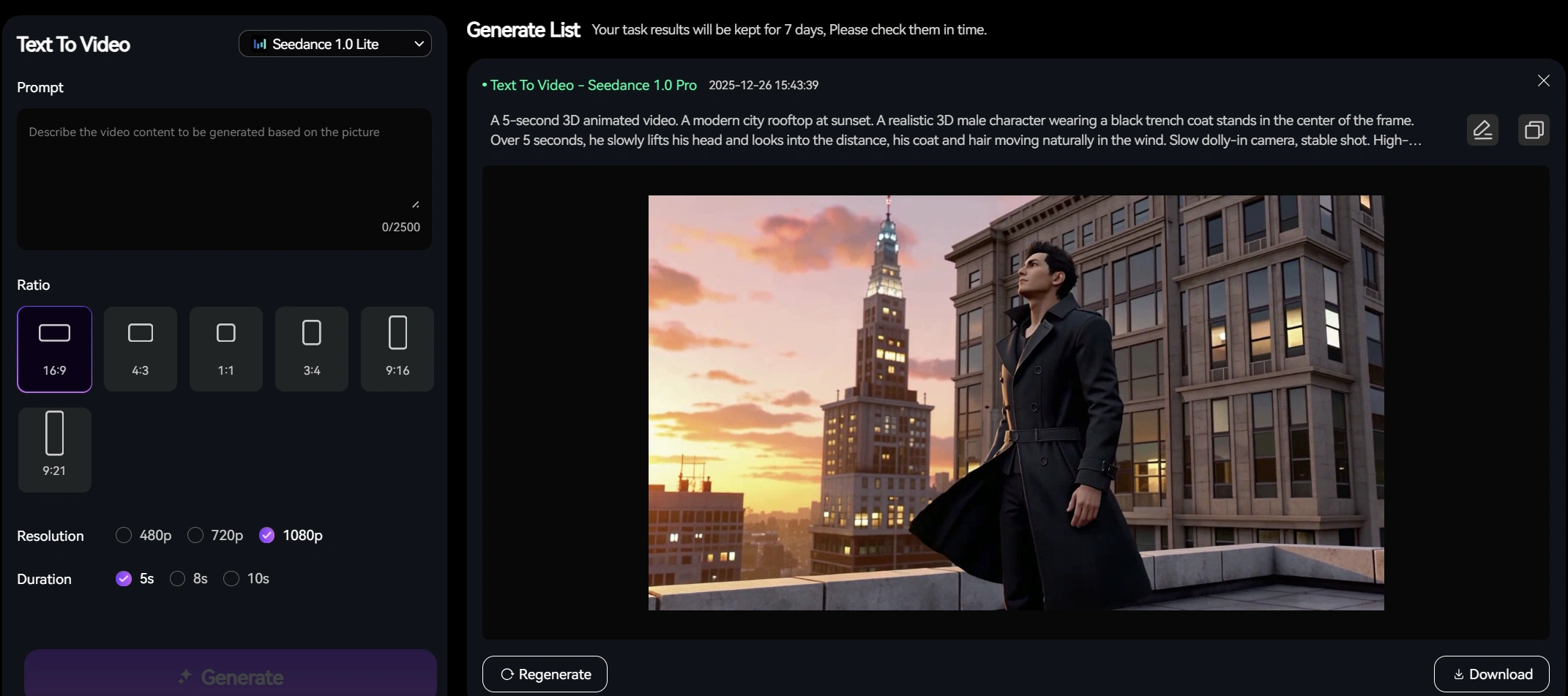
This is why the next evolution is not just about better models, but better integration. A centralized platform that unifies these disparate tools into a single, cohesive ecosystem is no longer a luxury; it's a necessity for professional efficiency. A hub like the Genmi.ai studio is at the forefront of this movement. It’s built on the understanding that a creator needs a workbench, not a chaotic toolbox.
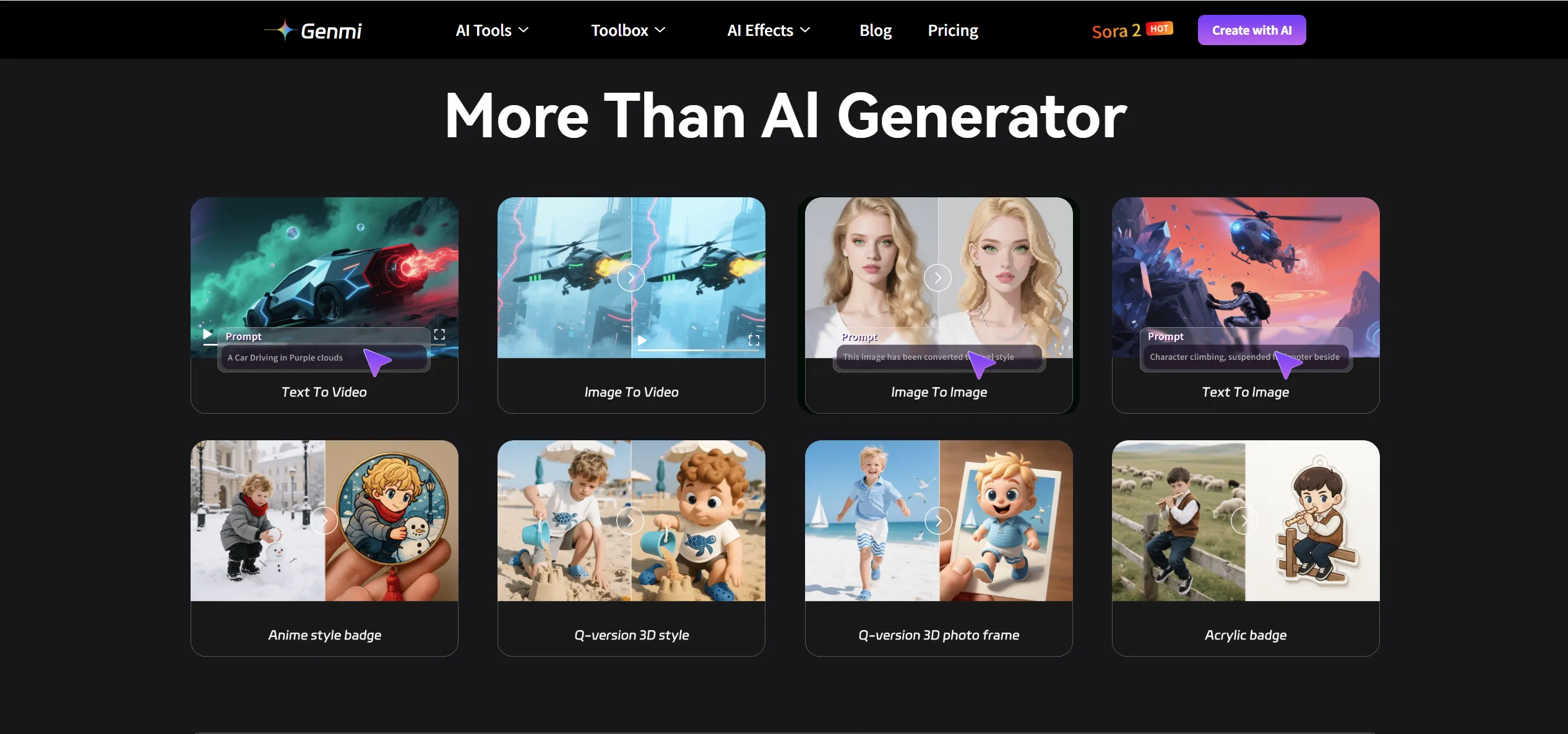
Imagine a seamless workflow where you can generate initial concepts using powerful text-to-image models, then instantly send that static image to multiple image-to-video tools to see which provides the best motion. Within the same interface, you can compare the cinematic flair of a Veo output with the raw power of a Sora composition. You can then use an integrated AI video analyzer to technically evaluate the results before committing to a final render. The ability to apply a consistent set of artistic AI effects across all your projects ensures brand consistency and saves countless hours. This is the future of our industry—a unified space where creativity, not platform management, is the focus.
Conclusion
So, which is the best AI to compose animation videos? The answer is: "the right one for the job at hand." The era of the single "master algorithm" is over. The AI animation landscape of 2026 is a specialized, multi-faceted ecosystem that rewards strategic thinking. By reading this guide, you've gained a VFX supervisor's framework for navigating this complexity. You now understand how to deploy world simulators for ideation, control suites for execution, and pipeline accelerators for efficiency.
The most successful artists and studios in the coming years will be those who master the "hybrid workflow." They will leverage the unique strengths of each specialized tool, moving fluidly between platforms to achieve their creative vision. The ultimate goal is to build a seamless pipeline where AI serves as a powerful co-pilot, augmenting human creativity and dramatically expanding our productive capacity.
Your creativity shouldn't be limited by fragmented tools and chaotic workflows. It's time to consolidate your power and build within a unified, intelligent creative ecosystem. Begin orchestrating your complete AI production pipeline with Genmi.ai.
Recommended Articles
Google Veo 3.1 Review: A VFX Pro's Verdict on the New Frontier of Video Synthesis
We tested Google Veo 3.1 on audio, continuity, and asset consistency. Discover if this new model is ready for professional production workflows.
Canva AI Image Generator Review: Is it Enough for Professional Design?
We test the Canva AI image generator against professional standards. Discover its pros, cons, and why advanced creators are switching to robust alternatives.
Hedra AI Review: A Hands-On Test of Its Video Performance
Our in-depth Hedra AI review tests its lip sync, character animation, and full-body motion. See our hands-on results and find out if it's right for you.